Loading...
Join our Facebook Group: Join: Expats in Saudi Arabia
Loading...
Hajj is the annual Islamic pilgrimage to Mecca that every able-bodied Muslim who can afford it is obligated to perform at least once in their lifetime. Unlike other Saudi visas, the Hajj visa is a unique category with its own application process, quotas, and regulations. You cannot simply apply online. This guide explains how the Hajj visa system works, what you need, and how to prepare.
The Hajj visa is unlike any other visa Saudi Arabia issues. It is a special-purpose visa issued exclusively for the annual Hajj pilgrimage, which takes place during the Islamic month of Dhul Hijjah. The Saudi Ministry of Hajj and Umrah controls the entire process, and individual applications are not accepted. You must apply through an authorized Hajj travel agent or your country's official Hajj delegation.
Saudi Arabia assigns Hajj quotas to each country, typically allowing roughly 1,000 pilgrims per million Muslim population. This means demand far exceeds supply in many countries, and waiting lists can be years long. Some countries run lottery systems, while others use first-come-first-served or priority-based allocation.
The Hajj visa itself is free of charge from the Saudi government. However, the total cost of performing Hajj includes the mandatory package (transport, accommodation, food, and services in Saudi Arabia), which is managed by authorized operators. These packages range widely in price depending on the level of service, proximity to the Haram, and your country of departure.
The visa is valid only for the Hajj season (roughly 30-45 days around the Hajj dates) and restricts you to the holy cities of Mecca and Medina plus transit routes. It is a single-entry visa, and overstaying carries severe penalties including deportation and potential bans from future Hajj.
The Hajj visa is available exclusively to Muslims. Saudi Arabia requires that Hajj visa applicants are Muslim, and your passport or application must reflect this. Non-Muslims cannot obtain a Hajj visa. This is the only Saudi visa category with a religious eligibility requirement.
If you already live in Saudi Arabia on an iqama (residence permit), you apply for a domestic Hajj permit through the Nusuk platform or the Absher system rather than a visa. The process is different from external applicants: you register online, select a Hajj package from approved domestic operators, and receive a permit. Domestic Hajj packages are typically cheaper than international ones. The quota for domestic pilgrims (Saudi citizens and residents) is separate from international quotas.
The application process for Hajj is fundamentally different from other visas. You do not go to an embassy or apply online yourself. Instead, the process flows through authorized intermediaries.
Step 1: Find an authorized Hajj agent. Every country has officially recognized Hajj travel operators licensed by both the Saudi Ministry of Hajj and the local government. In many countries, the national Hajj commission or Islamic affairs ministry publishes a list of authorized agents. Only use licensed operators. Unlicensed agents are a major source of Hajj fraud, where people pay thousands of dollars and never receive a visa.
Step 2: Register and select a package. Hajj packages are all-inclusive and typically cover flights, accommodation in Mecca and Medina, ground transport between holy sites, meals, and religious guidance. Packages come in different tiers (economy, standard, premium, VIP) based on hotel proximity to the Haram and service levels. Register with your chosen agent early, as slots fill up quickly.
Step 3: Submit documents to your agent. The agent collects your passport, photographs, and supporting documents. They handle the visa application on your behalf through the Saudi Hajj portal. You do not interact with the Saudi embassy directly for a Hajj visa.
Step 4: Wait for visa approval. The Saudi Ministry of Hajj processes applications through the authorized agents. Processing times vary, but visas are typically issued 4-8 weeks before Hajj begins. Your agent will inform you of the approval and arrange your travel.
Step 5: Travel and perform Hajj. You travel to Saudi Arabia with your group. Upon arrival, you are received by your Mutawwif (licensed Hajj service provider in Saudi Arabia) who handles your accommodation, transport to holy sites, and logistical support throughout Hajj.
Hajj fraud is a serious and unfortunately common problem. Every year, thousands of Muslims are scammed by unlicensed operators who take payment and provide fake visas, or no visas at all. Only use agents officially authorized by your government and the Saudi Ministry of Hajj. Verify their license. If a deal seems too cheap to be true, it probably is. Report suspicious operators to your national Hajj authority.
Your authorized Hajj agent will guide you through the specific documents required for your country. However, the standard requirements are consistent across most nationalities.
Saudi Arabia requires biometric data (fingerprints) for Hajj visa applicants. This is collected by your Hajj agent at designated centers or at the Saudi embassy/consulate, depending on your country's process. Biometric collection is usually required in person.
The Hajj visa itself is issued free of charge by the Saudi government. However, the total cost of performing Hajj is substantial because it includes a mandatory all-inclusive package. Costs vary dramatically depending on your country of departure and the package tier you choose.
| Item | Typical Cost Range | Notes |
|---|---|---|
| Hajj visa fee | Free | Issued by Saudi government at no charge |
| Economy Hajj package | $4,000 - $7,000 | Shared rooms, farther from Haram, basic services |
| Standard Hajj package | $7,000 - $12,000 | Better hotel, closer to Haram, more services |
| Premium / VIP package | $12,000 - $25,000+ | 5-star hotels near Haram, private transport, premium meals |
| Vaccinations | $50 - $200 | Meningitis vaccine mandatory; others depending on origin |
| Personal expenses | $300 - $1,000 | Gifts, extra food, phone/SIM, qurbani (sacrifice) |
Prices from Western countries (US, UK, Europe, Australia) tend to be on the higher end due to flight costs and agency fees. Prices from countries closer to Saudi Arabia (Egypt, Pakistan, Indonesia, Malaysia) are typically lower. The Saudi government has introduced the Nusuk platform to increase transparency in Hajj pricing and reduce middleman costs, though the impact varies by country.
Hajj is physically demanding and takes place in extreme heat. Saudi Arabia imposes strict health requirements to protect pilgrims and prevent disease outbreaks in what is one of the largest annual gatherings of people on earth.
Hajj involves extensive walking (10-15 km per day in some rituals), standing for hours in extreme heat (Arafat can exceed 45°C / 113°F in June), and navigating very large crowds. Pilgrims with serious health conditions should consult their doctor before committing. Elderly and disabled pilgrims are accommodated (wheelchair access is available at most holy sites), but the physical demands should not be underestimated.
Common health issues during Hajj include heat exhaustion, dehydration, respiratory infections (due to close contact with millions of people), and foot injuries from extensive walking. Pack a basic medical kit with pain relievers, electrolyte sachets, blister plasters, hand sanitizer, and any personal medications.
Saudi Arabia provides free emergency healthcare to Hajj pilgrims at dedicated medical facilities in Mecca, Medina, and the holy sites. However, comprehensive travel health insurance is still strongly recommended to cover evacuations, extended hospital stays, or treatment after returning home.
Hajj follows the Islamic lunar calendar and shifts forward approximately 10-11 days each year relative to the Gregorian calendar. The exact dates depend on the moon sighting and are confirmed by Saudi authorities close to the time.
| Year | Expected Hajj Dates (approximate) | Day of Arafat |
|---|---|---|
| 2026 | May 27 - June 1 | May 28 (8th Dhul Hijjah: May 27) |
| 2027 | May 16 - May 21 | May 17 (approximate) |
| 2028 | May 5 - May 10 | May 6 (approximate) |
If you plan to perform Hajj in 2026, the timeline roughly looks like this:
Hajj is a profound spiritual experience, but it is also logistically intense. Understanding what to expect helps you prepare mentally and physically.
Most international pilgrims arrive at King Abdulaziz International Airport (JED) in Jeddah, which has a dedicated Hajj terminal for the pilgrimage season. From there, transport takes you to Mecca (approximately 1-1.5 hours by bus). Upon arriving in Mecca, most pilgrims perform Umrah (the lesser pilgrimage) before the official Hajj days begin. Your hotel accommodation in Mecca will be your base for several days.
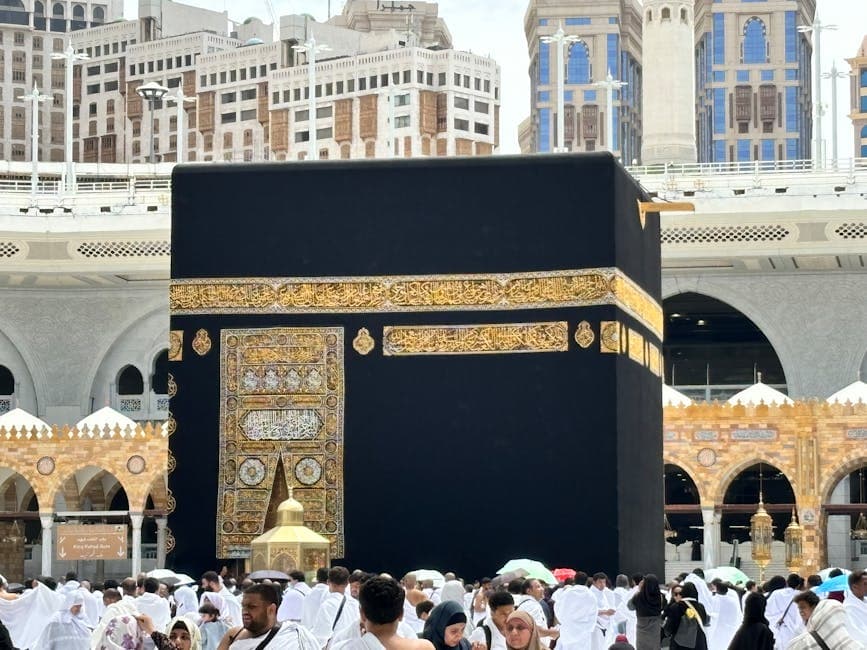
The core rituals of Hajj span 5-6 days. The key events include: standing at Arafat (the most important ritual, where pilgrims gather on the plain of Arafat from dawn to sunset), spending the night at Muzdalifah, the stoning of the Jamarat in Mina over three days, the Tawaf (circumambulation) around the Kaaba, and the Sa'i (walking between the hills of Safa and Marwah). Each day involves moving between sites, often in very large crowds and significant heat.
Pilgrims spend 3-4 nights in Mina, a massive tent city in the valley east of Mecca. The tents are air-conditioned (a relatively recent improvement) and organized by country and Hajj group. Conditions are basic but functional. Meals are provided by your Hajj package operator. The proximity of millions of people in a confined space means patience, tolerance, and good hygiene are essential.
Many pilgrims visit Medina before or after Hajj to visit the Prophet's Mosque (Al-Masjid an-Nabawi). Visiting Medina is not part of Hajj itself but is included in most Hajj packages. The Haramain High-Speed Rail connects Mecca and Medina in about 2.5 hours, and most packages include this transfer.
No. Hajj visas are only issued through authorized Hajj travel agents and official country delegations. You cannot apply directly at a Saudi embassy or online. The Saudi Ministry of Hajj manages the entire process through licensed intermediaries to ensure organized and safe pilgrimage logistics.
No. Saudi Arabia strictly prohibits performing Hajj on a tourist visa, visit visa, or any visa other than a dedicated Hajj visa (or domestic Hajj permit for residents). Police checkpoints on all roads leading to Mecca during Hajj season enforce this. Attempting to perform Hajj without proper authorization results in fines, deportation, and potential bans.
This varies enormously by country. In some countries (like Indonesia and Pakistan with very large Muslim populations), the waiting list can be 10-20+ years. In countries with smaller Muslim populations or higher quotas relative to demand (like many Western countries), you may be able to go within 1-2 years. Contact your national Hajj authority for current wait times.
Hajj is the major pilgrimage that takes place during specific dates in Dhul Hijjah and is one of the five pillars of Islam. It involves specific rituals at Mecca, Arafat, Muzdalifah, and Mina over 5-6 days. Umrah is the lesser pilgrimage that can be performed at any time of year and involves Tawaf and Sa'i only (fewer rituals, shorter duration). Umrah can be performed on a tourist visa or dedicated Umrah visa, while Hajj requires a specific Hajj visa. See our Umrah visa guide for details.
Women aged 45 and older may perform Hajj without a mahram if they travel as part of an organized group and submit a notarized no-objection letter from their mahram. Women under 45 generally must travel with a mahram. These rules have been gradually relaxed in recent years. Some countries interpret the requirements differently, so check with your local Hajj authority for the latest rules applicable to your nationality.
The Hajj visa is valid only for the pilgrimage period and does not allow extended stays or tourism outside of Mecca and Medina. You must depart Saudi Arabia by the date specified on your visa. Overstaying results in fines, deportation, and potential bans from future Hajj or entry to Saudi Arabia. If you want to combine Hajj with tourism, you would need to arrange a separate tourist visa for a different trip.
Start planning early. Contact your country's official Hajj authority to register, find authorized agents, and understand your country's quota and selection process.